2025
AiScopia
Augmented Clinical Intelligence for Cancer Diagnosis. Startup backed by Lanzadera
AI
Healthcare
Product Design
Intro
Faster diagnosis. More accurate results. AiScopia reimagines the cancer pathology workflow with AI integration. ✨
My role in the project
Designer on founding team · Spanning product, strategy, and execution. I led the 0-1 design of AiScopia's AI-assisted pathology platform, making core design decisions around AI interaction patterns and clinical workflows. I shaped business strategy and pitch narrative alongside the founding team, and implemented front-end across the product.
Problem Research
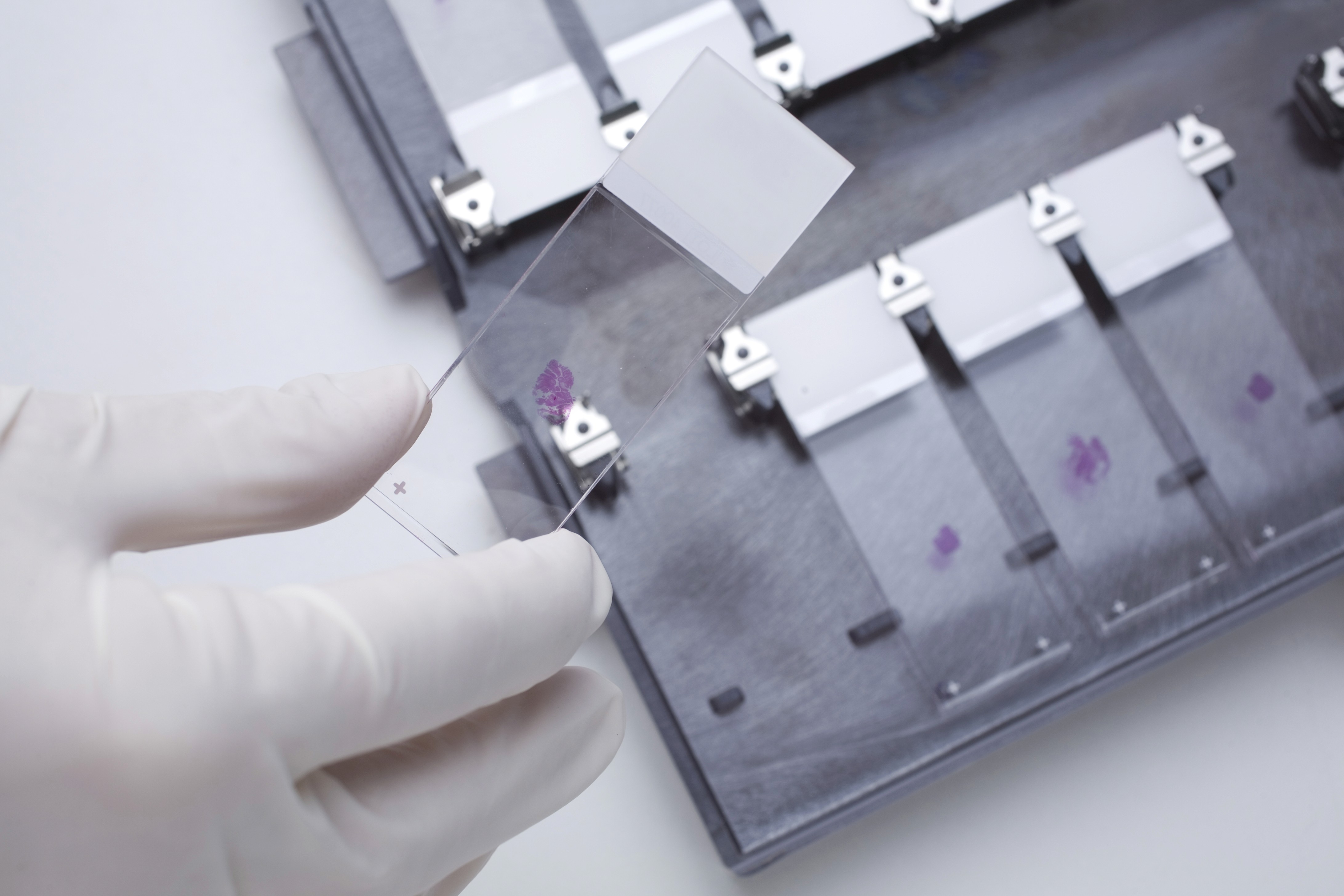
Through interviews with pathologists, laboratory directors, and hospital administrators across the US and Spain, including institutions like UCSF, which receives nearly 35,000 slides per year, we identified 2 core problems
Diagnostic Inconsistency
A pathologist's diagnosis depends not just on expertise, but on experience, fatigue, and focus on any given day. Studies show a 25% discrepancy rate across pathology diagnoses — meaning the same slide can yield a different result depending on who reads it, and when. For patients, that variability isn't abstract. It's the difference between the right treatment and the wrong one.
Gap between Supply and Demand
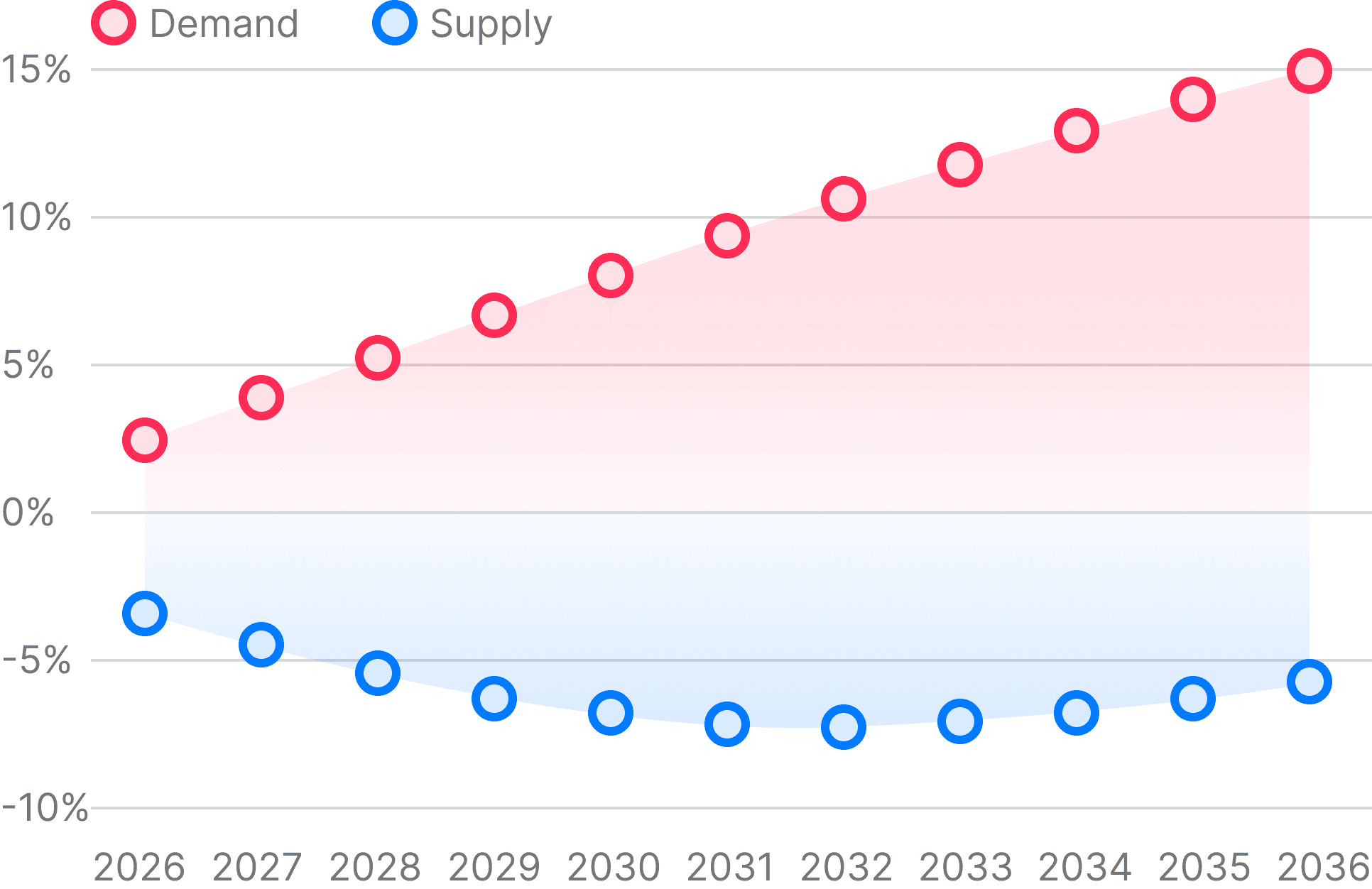
At the same time, the field is facing a structural crisis. The number of practicing pathologists is declining — fewer medical students are choosing the specialty — while the volume of cases continues to grow. The people responsible for one of the most critical steps in cancer diagnosis are being asked to do more, with less. That pressure compounds the inconsistency problem: when pathologists are overloaded, accuracy suffers.
Market Opportunity
Pathology industry is at an inflection point. Tools are fragmented, digital adoption is accelerating, and AI is ready to transform diagnosis at scale.
Analogue Infrastructure
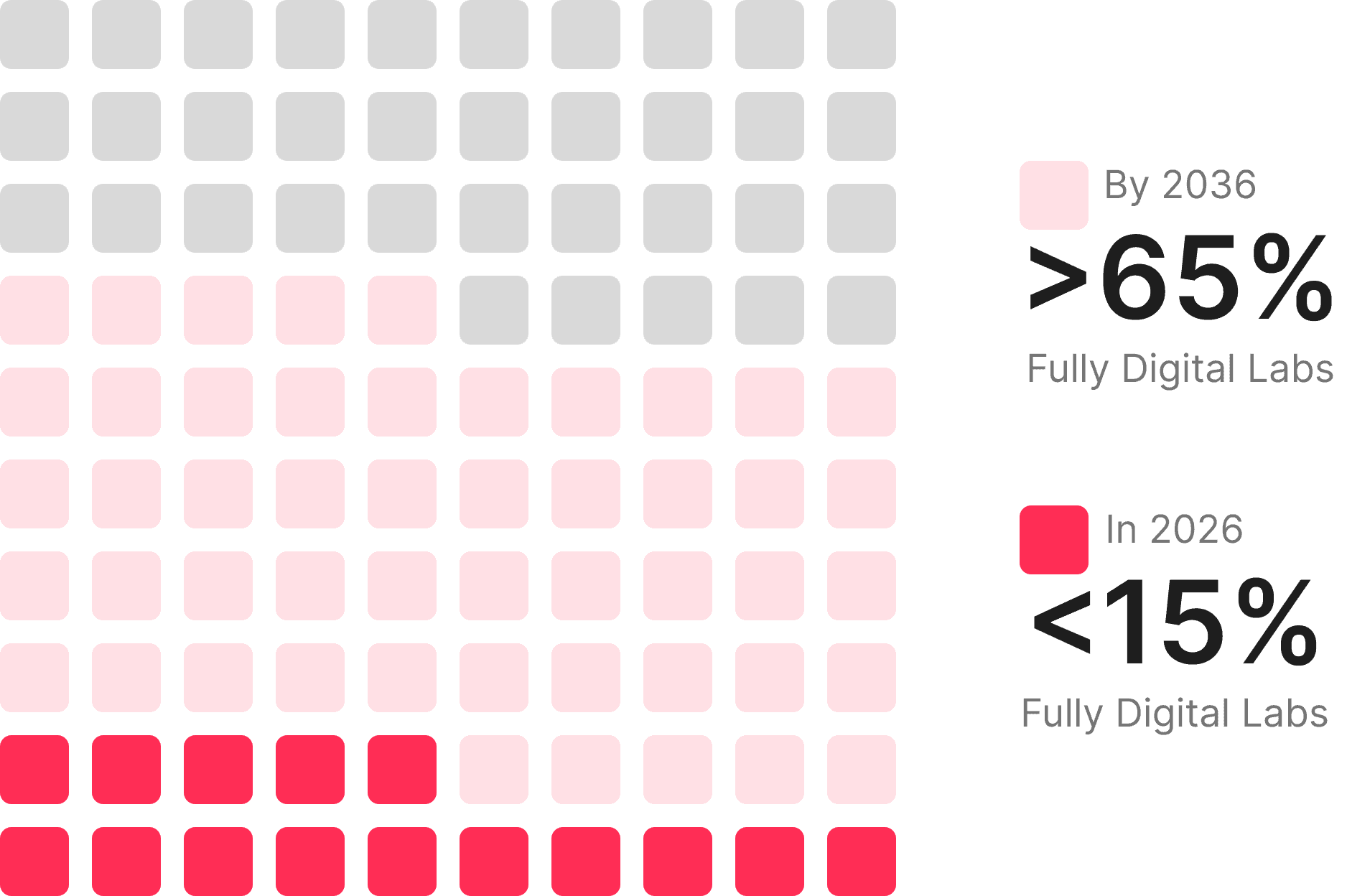
Surprisingly, in 2026, you might still find pathology laboratories using old analogue microscopes, the same equipment from decades ago. Those tools are simply not keeping up with the volume of cases arriving today. However, there is a clear trend of transformation from non-digital to digital in pathology labs. After speaking with hospital directors, we found that 65% of hospitals are expected to transition to fully digital operations within the next 10 years. And the software infrastructure they will need, is exactly what we are building.
Disconnected Tools
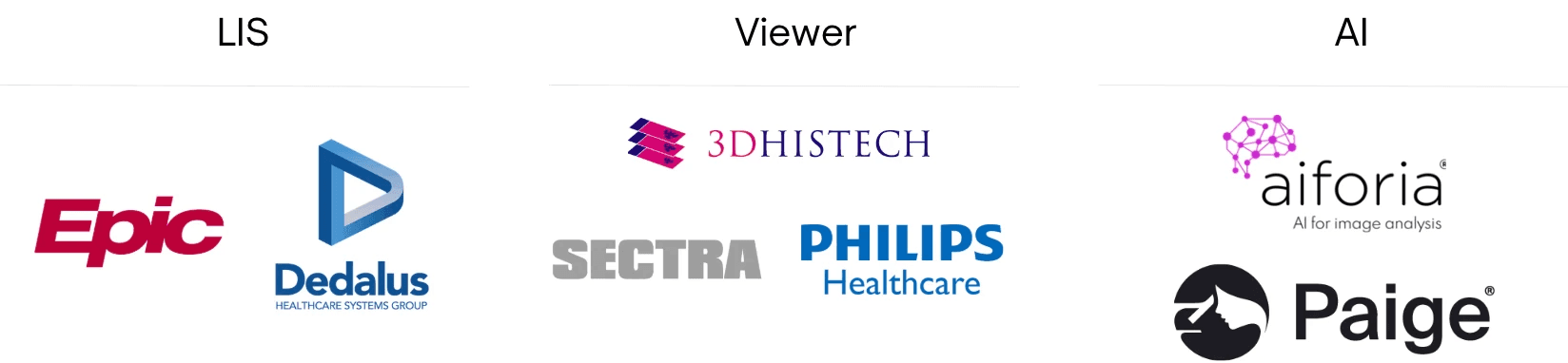
There are three type of tools that will be used in the market today. The first one is a laboratory information system, which tracks patient data. And the second one is a viewer, which allows pathologists to look at digital slides. And the third one, there are some AI tools that are emerging in the market today. But what's the problem here? None of the tools pathologists use allow them to communicate or collaborate, either within their own hospital or with external colleagues. And this is a white space that AiScopia steps into.
Solution
One unified AI-powered platform
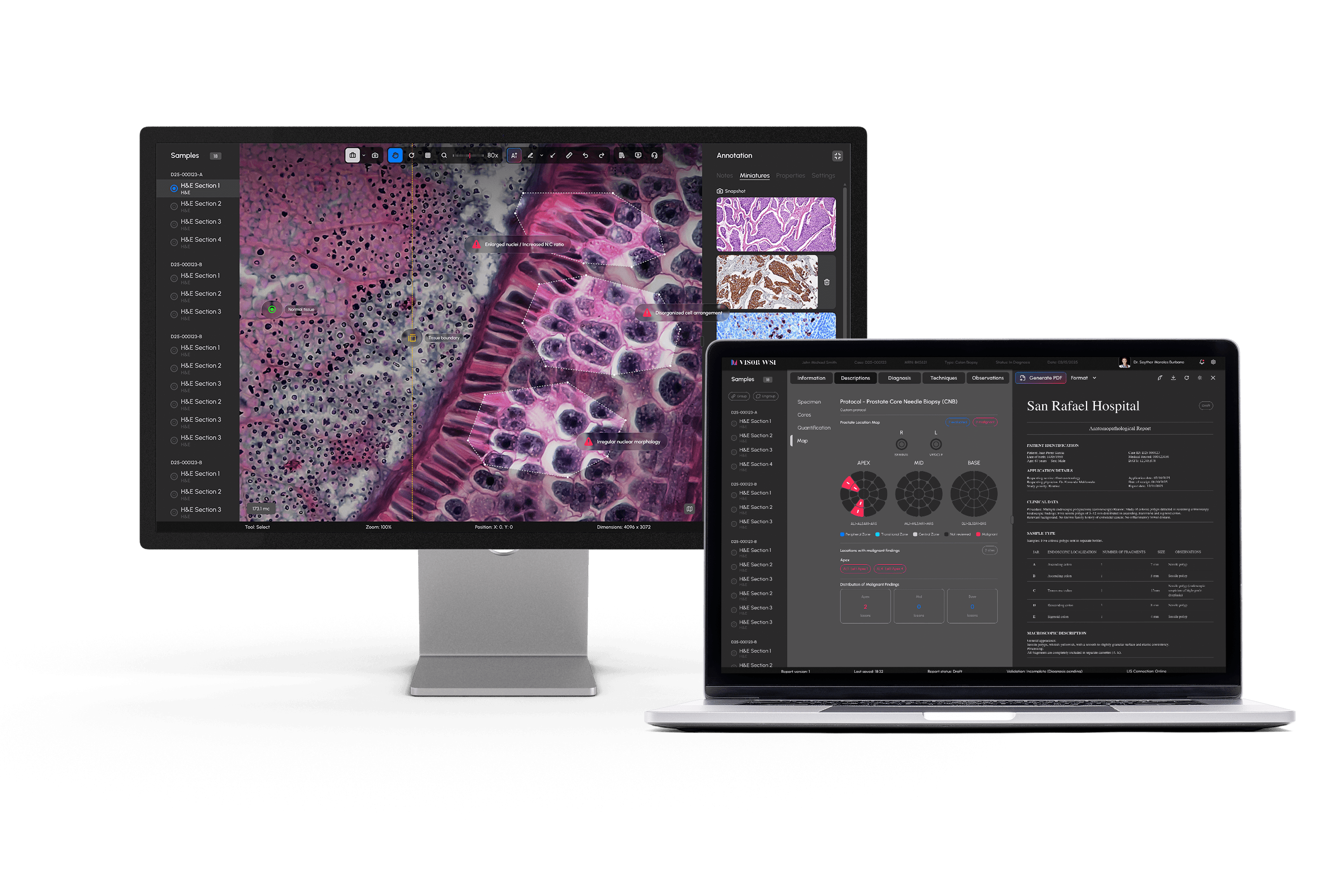
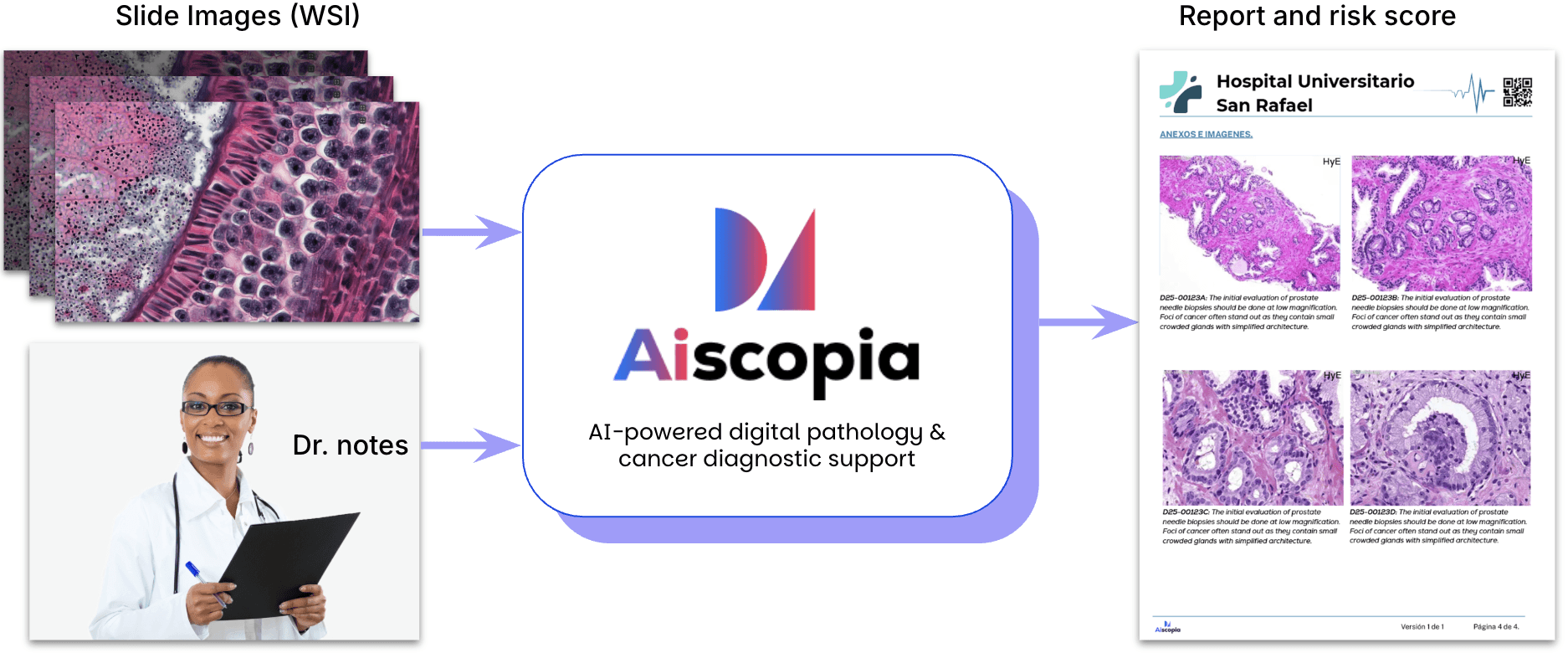
AiScopia brings the full diagnostic process into one AI-powered platform — combining whole slide image analysis, intelligent annotation, and automated report generation to help clinicians work faster and diagnose with greater confidence.
Design Process
Design Process
System
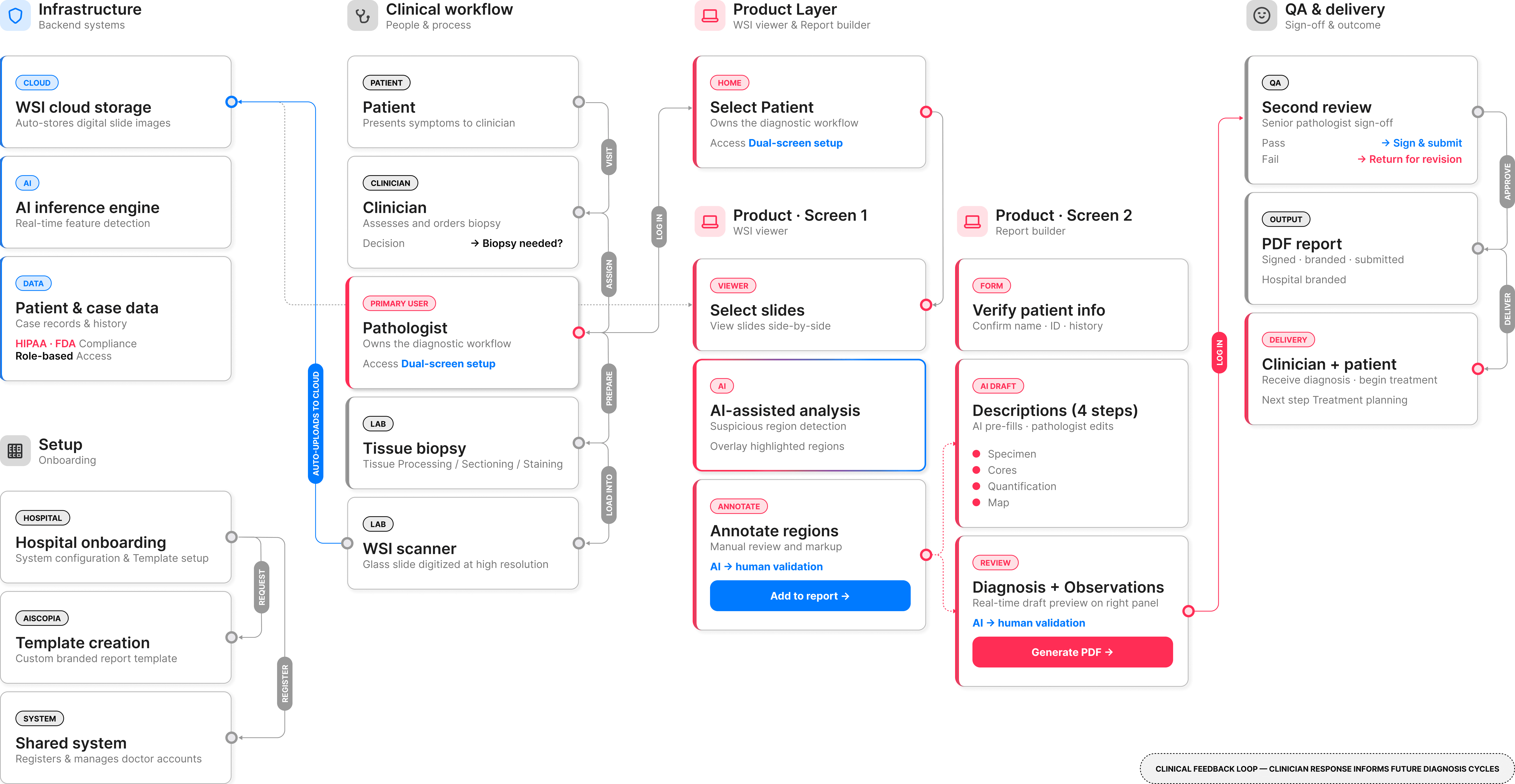
I started by mapping the full system architecture before touching any interface.
A patient presents symptoms → clinician orders a biopsy → tissue is processed and scanned into a WSI → the pathologist reviews slides, runs AI-assisted analysis, and annotates regions → a structured report is auto-generated, reviewed by a senior pathologist, and delivered as a signed PDF to the clinician and patient.
Sketch
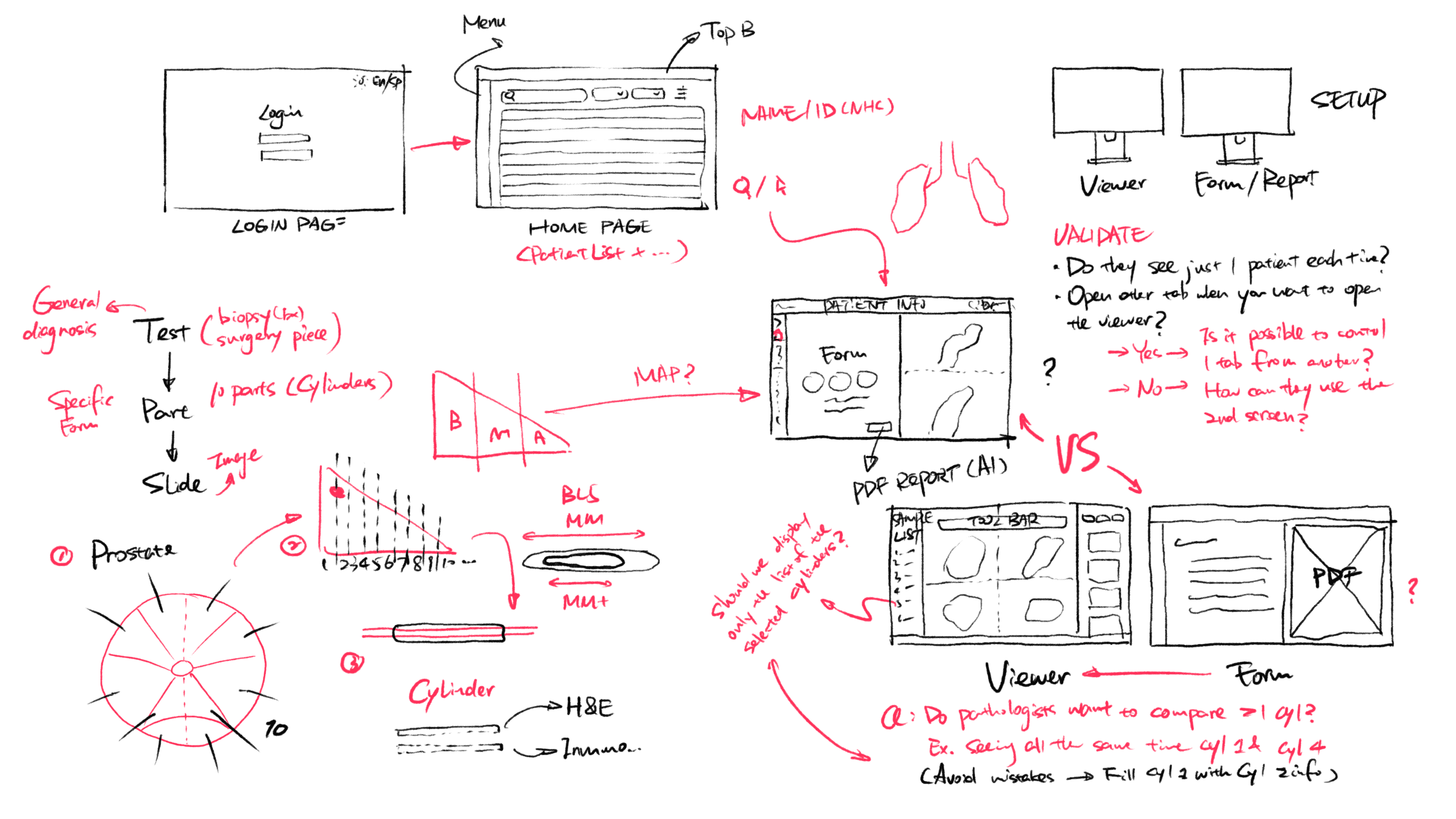
With the system mapped, I moved to sketching — working out the login-to-report flow, the dual-screen setup, and open questions like how pathologists navigate between biopsies and whether they need to compare multiple slides at once, etc.
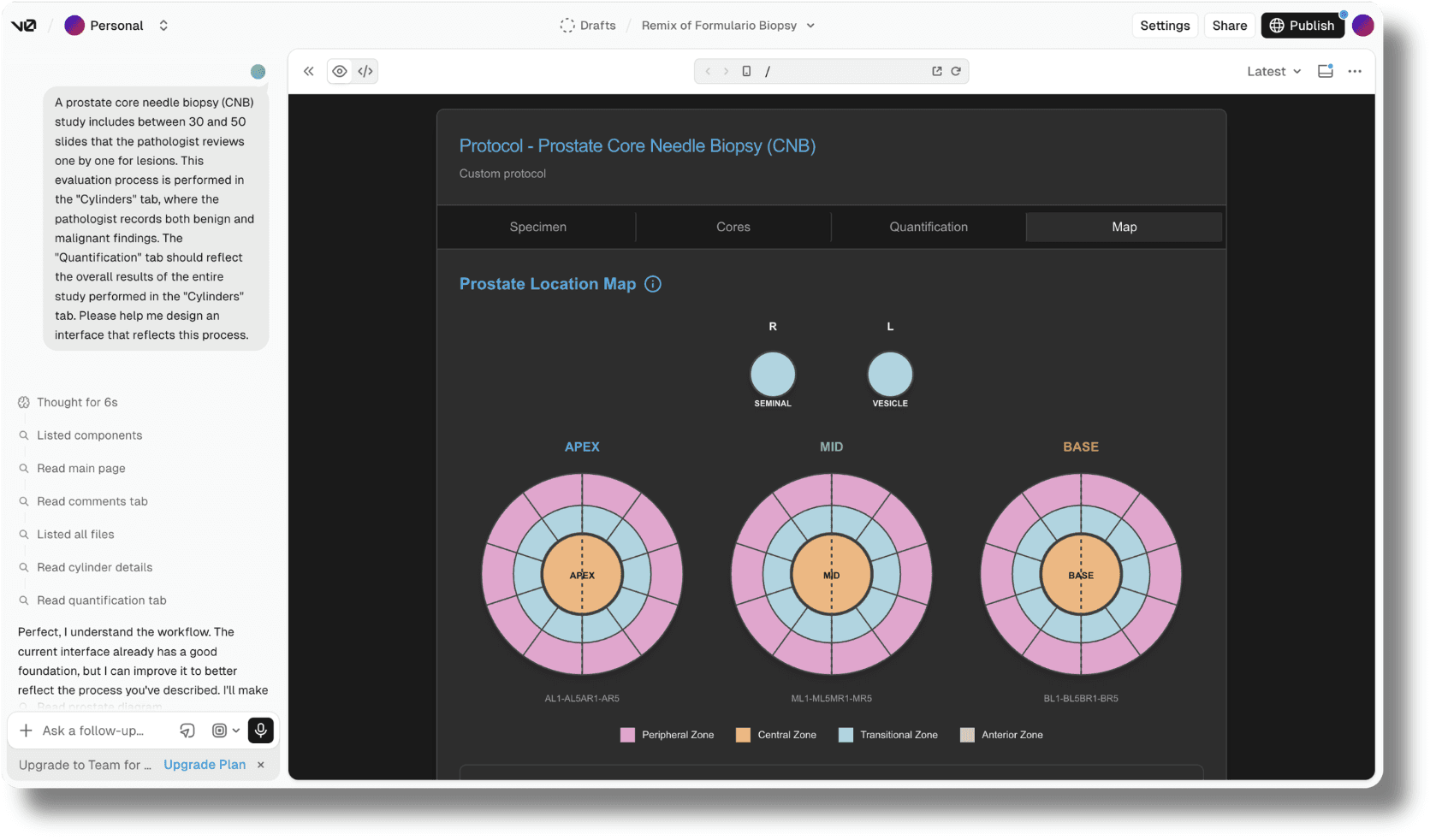
Initial design ideation in V0
I collaborated directly with a pathologist in V0 to build out the detailed components of each interface segment — translating their clinical knowledge into UI fragments that would later become the foundation for the full design.
Low-High Fidelity Prototype
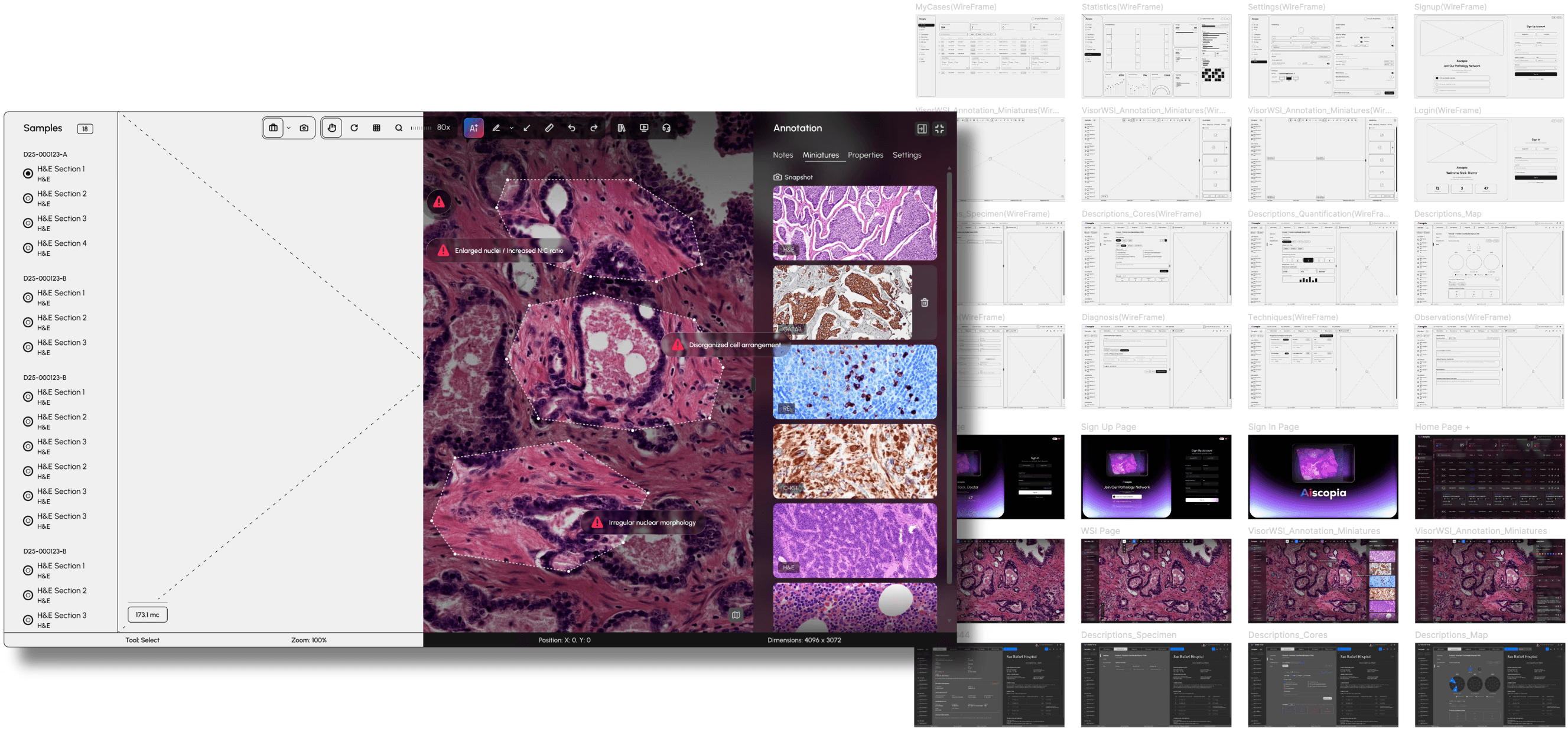
I designed the wireframes and key high-fidelity screens myself, then used Claude's MCP integration in Figma to extend the design — generating similar-layout pages based on what I'd already built.
The key insight: AI excels at replication, but struggles to meet specific design requirements from scratch.
Design to Development
Design to deployment — from Figma to a running product
I set up the project infrastructure first — repository on GitLab, backend connections, and a clear README — then brought Claude in to write the frontend code by feeding it Figma designs directly alongside written descriptions. Claude handled much of the UX implementation; I iterated and refined over two weeks until the product was running.
Value Proposition
What it actually means for hospitals and individual patients?
For Hospitals & Labs
For Patients
Fewer diagnostic errors
Faster report turnaround
Eliminate physical shipping costs
Scalable remote diagnosis
More accurate diagnoses
Faster access to treatment
Lower cost of care
Equal quality regardless of location
Landing & Next Step
Joined Lanzadera Accelerator
We joined Lanzadera in March, 2026. It is a prominent startup accelerator based in Valencia, Spain. Founded in 2013 by Juan Roig (president of the supermarket chain Mercadona), it provides entrepreneurs with funding, physical workspace, mentoring, and networking to help scale robust business models.

Commercial discussions with Quironsalud
Project advanced into commercial discussions with Quironsalud, one of Spain's largest hospital networks in May, 2026
Team
Meet the team behind AiScopia

Learnings
From Designer to Builder
This project pushed me beyond the boundaries of design. Building the frontend myself — setting up the repository, writing code with AI, and shipping a running product — changed how I think about design decisions. When you understand the implementation, you design differently: more precisely, more practically, and with a clearer sense of what actually matters.
Design as Entrepreneurship
AiScopia was also my first real experience inside a startup. Through the process, I learned to think beyond design — understanding market sizing, business modelling, unit economics, and go-to-market strategy. Being part of the Lanzadera accelerator meant joining real pitches to VCs and hospital directors, and learning to evaluate whether a problem is truly worth building a startup around. Design brought me to the table, but entrepreneurship taught me how to stay there.
More Works
(GQ® — 02)
©2026

FAQ
01
What tools and technologies used in the project?
02
What is your inpiration?
03
How does the product stand out from the market? What is the result from compatible research?
04
What do you want to improve in the future?
2025
AiScopia
Augmented Clinical Intelligence for Cancer Diagnosis. Startup backed by Lanzadera
AI
Healthcare
Product Design
Intro
Faster diagnosis. More accurate results. AiScopia reimagines the cancer pathology workflow with AI integration. ✨
My role in the project
Designer on founding team · Spanning product, strategy, and execution. I led the 0-1 design of AiScopia's AI-assisted pathology platform, making core design decisions around AI interaction patterns and clinical workflows. I shaped business strategy and pitch narrative alongside the founding team, and implemented front-end across the product.
Problem Research
Through interviews with pathologists, laboratory directors, and hospital administrators across the US and Spain, including institutions like UCSF, which receives nearly 35,000 slides per year, we identified 2 core problems
Diagnostic Inconsistency
A pathologist's diagnosis depends not just on expertise, but on experience, fatigue, and focus on any given day. Studies show a 25% discrepancy rate across pathology diagnoses — meaning the same slide can yield a different result depending on who reads it, and when. For patients, that variability isn't abstract. It's the difference between the right treatment and the wrong one.
Gap between Supply and Demand
At the same time, the field is facing a structural crisis. The number of practicing pathologists is declining — fewer medical students are choosing the specialty — while the volume of cases continues to grow. The people responsible for one of the most critical steps in cancer diagnosis are being asked to do more, with less. That pressure compounds the inconsistency problem: when pathologists are overloaded, accuracy suffers.
Market Opportunity
Pathology industry is at an inflection point. Tools are fragmented, digital adoption is accelerating, and AI is ready to transform diagnosis at scale.
Analogue Infrastructure
Surprisingly, in 2026, you might still find pathology laboratories using old analogue microscopes, the same equipment from decades ago. Those tools are simply not keeping up with the volume of cases arriving today. However, there is a clear trend of transformation from non-digital to digital in pathology labs. After speaking with hospital directors, we found that 65% of hospitals are expected to transition to fully digital operations within the next 10 years. And the software infrastructure they will need, is exactly what we are building.
Disconnected Tools
There are three type of tools that will be used in the market today. The first one is a laboratory information system, which tracks patient data. And the second one is a viewer, which allows pathologists to look at digital slides. And the third one, there are some AI tools that are emerging in the market today. But what's the problem here? None of the tools pathologists use allow them to communicate or collaborate, either within their own hospital or with external colleagues. And this is a white space that AiScopia steps into.
Solution
One unified AI-powered platform
AiScopia brings the full diagnostic process into one AI-powered platform — combining whole slide image analysis, intelligent annotation, and automated report generation to help clinicians work faster and diagnose with greater confidence.
Design Process
Design Process
System
I started by mapping the full system architecture before touching any interface.
A patient presents symptoms → clinician orders a biopsy → tissue is processed and scanned into a WSI → the pathologist reviews slides, runs AI-assisted analysis, and annotates regions → a structured report is auto-generated, reviewed by a senior pathologist, and delivered as a signed PDF to the clinician and patient.
Sketch
With the system mapped, I moved to sketching — working out the login-to-report flow, the dual-screen setup, and open questions like how pathologists navigate between biopsies and whether they need to compare multiple slides at once, etc.
Initial design ideation in V0
I collaborated directly with a pathologist in V0 to build out the detailed components of each interface segment — translating their clinical knowledge into UI fragments that would later become the foundation for the full design.
Low-High Fidelity Prototype
I designed the wireframes and key high-fidelity screens myself, then used Claude's MCP integration in Figma to extend the design — generating similar-layout pages based on what I'd already built.
The key insight: AI excels at replication, but struggles to meet specific design requirements from scratch.
Design to Development
Design to deployment — from Figma to a running product
I set up the project infrastructure first — repository on GitLab, backend connections, and a clear README — then brought Claude in to write the frontend code by feeding it Figma designs directly alongside written descriptions. Claude handled much of the UX implementation; I iterated and refined over two weeks until the product was running.
Value Proposition
What it actually means for hospitals and individual patients?
For Hospitals & Labs
For Patients
Fewer diagnostic errors
Faster report turnaround
Eliminate physical shipping costs
Scalable remote diagnosis
More accurate diagnoses
Faster access to treatment
Lower cost of care
Equal quality regardless of location
Landing & Next Step
Joined Lanzadera Accelerator
We joined Lanzadera in March, 2026. It is a prominent startup accelerator based in Valencia, Spain. Founded in 2013 by Juan Roig (president of the supermarket chain Mercadona), it provides entrepreneurs with funding, physical workspace, mentoring, and networking to help scale robust business models.
Commercial discussions with Quironsalud
Project advanced into commercial discussions with Quironsalud, one of Spain's largest hospital networks in May, 2026
Team
Meet the team behind AiScopia
Learnings
From Designer to Builder
This project pushed me beyond the boundaries of design. Building the frontend myself — setting up the repository, writing code with AI, and shipping a running product — changed how I think about design decisions. When you understand the implementation, you design differently: more precisely, more practically, and with a clearer sense of what actually matters.
Design as Entrepreneurship
AiScopia was also my first real experience inside a startup. Through the process, I learned to think beyond design — understanding market sizing, business modelling, unit economics, and go-to-market strategy. Being part of the Lanzadera accelerator meant joining real pitches to VCs and hospital directors, and learning to evaluate whether a problem is truly worth building a startup around. Design brought me to the table, but entrepreneurship taught me how to stay there.
More Works
©2026
FAQ
What tools and technologies used in the project?
What is your inpiration?
How does the product stand out from the market? What is the result from compatible research?
What do you want to improve in the future?
2025
AiScopia
Augmented Clinical Intelligence for Cancer Diagnosis. Startup backed by Lanzadera
AI
Healthcare
Product Design
Intro
Faster diagnosis. More accurate results. AiScopia reimagines the cancer pathology workflow with AI integration. ✨
My role in the project
Designer on founding team · Spanning product, strategy, and execution. I led the 0-1 design of AiScopia's AI-assisted pathology platform, making core design decisions around AI interaction patterns and clinical workflows. I shaped business strategy and pitch narrative alongside the founding team, and implemented front-end across the product.
Problem Research
Through interviews with pathologists, laboratory directors, and hospital administrators across the US and Spain, including institutions like UCSF, which receives nearly 35,000 slides per year, we identified 2 core problems
Diagnostic Inconsistency
A pathologist's diagnosis depends not just on expertise, but on experience, fatigue, and focus on any given day. Studies show a 25% discrepancy rate across pathology diagnoses — meaning the same slide can yield a different result depending on who reads it, and when. For patients, that variability isn't abstract. It's the difference between the right treatment and the wrong one.
Gap between Supply and Demand
At the same time, the field is facing a structural crisis. The number of practicing pathologists is declining — fewer medical students are choosing the specialty — while the volume of cases continues to grow. The people responsible for one of the most critical steps in cancer diagnosis are being asked to do more, with less. That pressure compounds the inconsistency problem: when pathologists are overloaded, accuracy suffers.
Market Opportunity
Pathology industry is at an inflection point. Tools are fragmented, digital adoption is accelerating, and AI is ready to transform diagnosis at scale.
Analogue Infrastructure
Surprisingly, in 2026, you might still find pathology laboratories using old analogue microscopes, the same equipment from decades ago. Those tools are simply not keeping up with the volume of cases arriving today. However, there is a clear trend of transformation from non-digital to digital in pathology labs. After speaking with hospital directors, we found that 65% of hospitals are expected to transition to fully digital operations within the next 10 years. And the software infrastructure they will need, is exactly what we are building.
Disconnected Tools
There are three type of tools that will be used in the market today. The first one is a laboratory information system, which tracks patient data. And the second one is a viewer, which allows pathologists to look at digital slides. And the third one, there are some AI tools that are emerging in the market today. But what's the problem here? None of the tools pathologists use allow them to communicate or collaborate, either within their own hospital or with external colleagues. And this is a white space that AiScopia steps into.
Solution
One unified AI-powered platform
AiScopia brings the full diagnostic process into one AI-powered platform — combining whole slide image analysis, intelligent annotation, and automated report generation to help clinicians work faster and diagnose with greater confidence.
Design Process
Design Process
System
I started by mapping the full system architecture before touching any interface.
A patient presents symptoms → clinician orders a biopsy → tissue is processed and scanned into a WSI → the pathologist reviews slides, runs AI-assisted analysis, and annotates regions → a structured report is auto-generated, reviewed by a senior pathologist, and delivered as a signed PDF to the clinician and patient.
Sketch
With the system mapped, I moved to sketching — working out the login-to-report flow, the dual-screen setup, and open questions like how pathologists navigate between biopsies and whether they need to compare multiple slides at once, etc.
Initial design ideation in V0
I collaborated directly with a pathologist in V0 to build out the detailed components of each interface segment — translating their clinical knowledge into UI fragments that would later become the foundation for the full design.
Low-High Fidelity Prototype
I designed the wireframes and key high-fidelity screens myself, then used Claude's MCP integration in Figma to extend the design — generating similar-layout pages based on what I'd already built.
The key insight: AI excels at replication, but struggles to meet specific design requirements from scratch.
Design to Development
Design to deployment — from Figma to a running product
I set up the project infrastructure first — repository on GitLab, backend connections, and a clear README — then brought Claude in to write the frontend code by feeding it Figma designs directly alongside written descriptions. Claude handled much of the UX implementation; I iterated and refined over two weeks until the product was running.
Value Proposition
What it actually means for hospitals and individual patients?
For Hospitals & Labs
For Patients
Fewer diagnostic errors
Faster report turnaround
Eliminate physical shipping costs
Scalable remote diagnosis
More accurate diagnoses
Faster access to treatment
Lower cost of care
Equal quality regardless of location
Landing & Next Step
Joined Lanzadera Accelerator
We joined Lanzadera in March, 2026. It is a prominent startup accelerator based in Valencia, Spain. Founded in 2013 by Juan Roig (president of the supermarket chain Mercadona), it provides entrepreneurs with funding, physical workspace, mentoring, and networking to help scale robust business models.
Commercial discussions with Quironsalud
Project advanced into commercial discussions with Quironsalud, one of Spain's largest hospital networks in May, 2026
Team
Meet the team behind AiScopia
Learnings
From Designer to Builder
This project pushed me beyond the boundaries of design. Building the frontend myself — setting up the repository, writing code with AI, and shipping a running product — changed how I think about design decisions. When you understand the implementation, you design differently: more precisely, more practically, and with a clearer sense of what actually matters.
Design as Entrepreneurship
AiScopia was also my first real experience inside a startup. Through the process, I learned to think beyond design — understanding market sizing, business modelling, unit economics, and go-to-market strategy. Being part of the Lanzadera accelerator meant joining real pitches to VCs and hospital directors, and learning to evaluate whether a problem is truly worth building a startup around. Design brought me to the table, but entrepreneurship taught me how to stay there.
More Works
(GQ® — 02)
©2026
FAQ
01
What tools and technologies used in the project?
02
What is your inpiration?
03
How does the product stand out from the market? What is the result from compatible research?
04
What do you want to improve in the future?